Big Creek Transmission Line
Dublin Core
Title
Big Creek Transmission Line
Description
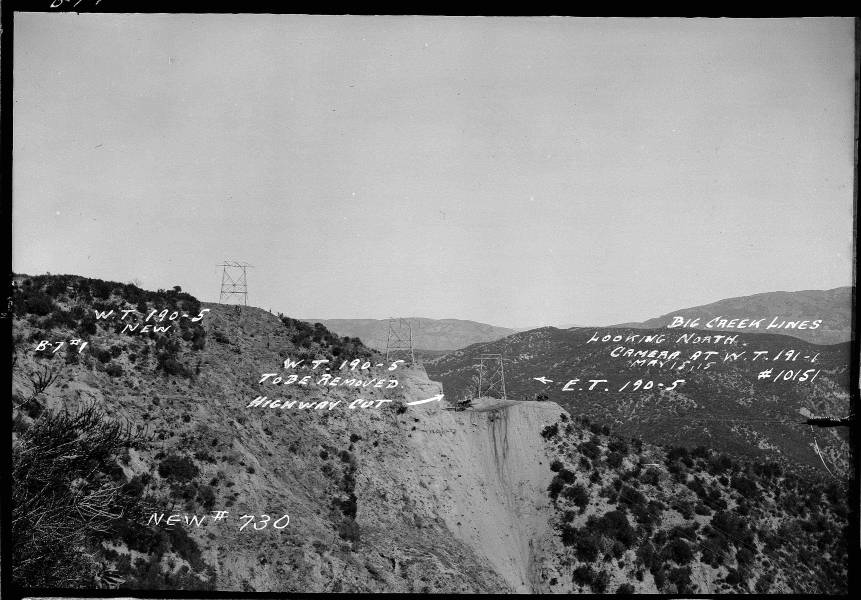
In the early 1900s, Los Angeles and Henry Huntington’s Pacific Electric railway were rapidly expanding. With greater demands of electrical power, Henry Huntington decided to finance the Big Creek project – America’s first extensive hydroelectric project, conceived by John Eastwood [1]. John Eastwood was an engineer who, after surveying the San Joaquin River region, keenly noticed that it was a prime location to leverage the soaring mountain streams [1]. Construction of the Big Creek Hydroelectric project began in 1910 and by 1928, produced 1,600 GWh [6]. In 1921, Big Creek became the first plant in the world designed to transmit power at 220 kilovolts [4]. For comparison, Hoover Dam did not begin transmitting energy until October 1936 [6]. The photo above depicts three of Big Creek’s transmission line towers that carried electricity from Sierra National Forest in Fresno County to the Eagle Rock Substation in Los Angeles through a 241 mile transmission corridor [7]. The sheer might of the towers is visible.These steel lattice towers ranged from 30 to 60 feet tall [2] and upon closer inspection, a greater sense of the elevation and abundance of energy can be recognized. The photograph also notes that one tower is to be removed although the reason for doing so is unclear.
Works Cited
[1] “100 Years Young: Big Creek Hydroelectric Plant Still Going Strong.” Edison International | Newsroom, https://newsroom.edison.com/stories/100-years-young:-big-creek-hydroelectric-plant-still-going-strong. Accessed 17 Mar. 2026.
[2] “Power Lines Around Los Angeles: Isolation, Interconnection, and Aesthetics.” Boom California, 21 May 2020, https://boomcalifornia.org/2020/05/21/power-lines-around-los-angeles-isolation-interconnection-and-aesthetics/.
[3] Fox, Donna, Robert J. McEliece, and Babak Hassibi. “An Electrifying Century: An Early History of the Caltech EE Department.” ENGenious, 8 Oct. 2010, engenious.caltech.edu/articles/history-EE-Department-century. Accessed 5 Feb. 2026.
[4] Heilbron, J. L., and Robert W. Seidel. Lawrence and His Laboratory: A History of the Lawrence Berkeley Laboratory, University of California Press, 1990. UC Press E-Books Collection, https://publishing.cdlib.org/ucpressebooks/view?docId=ft5s200764&chunk.id=[section
identifier]. Accessed 5 Feb. 2026.
[5] Millikan, Robert A., and Royal W. Sorensen. Brief for Millikan and Sorensen. Robert A. Millikan and Royal W. Sorensen v. Talma T. Greenwood, Interference No. 56557, United States Patent Office, [Year, e.g., 1928], [Collection Name, e.g., Royal W. Sorensen Papers], [Box 3], Caltech Archives, Pasadena, CA.
[6] Ornelas, Gabriela. “Big Creek’s Powerhouse 8 Marks 100 Years of Hydroelectric Power.” Energized by Edison, 8 Oct. 2021, energized.edison.com/stories/big-creeks-powerhouse-8-marks-100-years-of-hydroelectric-power. Accessed 5 Feb. 2026.
[7] Record, Historic American Engineering. Big Creek Hydroelectric System, East & West Transmission Line, 241-Mile Transmission Corridor Extending between the Big Creek Hydroelectric System in the Sierra National Forest in Fresno County and the Eagle Rock Substation in Los Angeles, California, Visalia, Tulare County, CA. Still image. California -- Tulare County -- Visalia, https://www.loc.gov/pictures/item/ca3976/. Accessed 17 Mar. 2026.
[8] Sorensen, Royal W., and Hallan E. Mendenhall. “Vacuum Switching Experiments at California Institute of Technology.” Transactions of the American Institute of Electrical Engineers, XLV, Jan. 1926, pp. 1102–07. Semantic Scholar, https://doi.org/10.1109/T-AIEE.1926.5061306.
Works Cited
[1] “100 Years Young: Big Creek Hydroelectric Plant Still Going Strong.” Edison International | Newsroom, https://newsroom.edison.com/stories/100-years-young:-big-creek-hydroelectric-plant-still-going-strong. Accessed 17 Mar. 2026.
[2] “Power Lines Around Los Angeles: Isolation, Interconnection, and Aesthetics.” Boom California, 21 May 2020, https://boomcalifornia.org/2020/05/21/power-lines-around-los-angeles-isolation-interconnection-and-aesthetics/.
[3] Fox, Donna, Robert J. McEliece, and Babak Hassibi. “An Electrifying Century: An Early History of the Caltech EE Department.” ENGenious, 8 Oct. 2010, engenious.caltech.edu/articles/history-EE-Department-century. Accessed 5 Feb. 2026.
[4] Heilbron, J. L., and Robert W. Seidel. Lawrence and His Laboratory: A History of the Lawrence Berkeley Laboratory, University of California Press, 1990. UC Press E-Books Collection, https://publishing.cdlib.org/ucpressebooks/view?docId=ft5s200764&chunk.id=[section
identifier]. Accessed 5 Feb. 2026.
[5] Millikan, Robert A., and Royal W. Sorensen. Brief for Millikan and Sorensen. Robert A. Millikan and Royal W. Sorensen v. Talma T. Greenwood, Interference No. 56557, United States Patent Office, [Year, e.g., 1928], [Collection Name, e.g., Royal W. Sorensen Papers], [Box 3], Caltech Archives, Pasadena, CA.
[6] Ornelas, Gabriela. “Big Creek’s Powerhouse 8 Marks 100 Years of Hydroelectric Power.” Energized by Edison, 8 Oct. 2021, energized.edison.com/stories/big-creeks-powerhouse-8-marks-100-years-of-hydroelectric-power. Accessed 5 Feb. 2026.
[7] Record, Historic American Engineering. Big Creek Hydroelectric System, East & West Transmission Line, 241-Mile Transmission Corridor Extending between the Big Creek Hydroelectric System in the Sierra National Forest in Fresno County and the Eagle Rock Substation in Los Angeles, California, Visalia, Tulare County, CA. Still image. California -- Tulare County -- Visalia, https://www.loc.gov/pictures/item/ca3976/. Accessed 17 Mar. 2026.
[8] Sorensen, Royal W., and Hallan E. Mendenhall. “Vacuum Switching Experiments at California Institute of Technology.” Transactions of the American Institute of Electrical Engineers, XLV, Jan. 1926, pp. 1102–07. Semantic Scholar, https://doi.org/10.1109/T-AIEE.1926.5061306.
Source
Southern California Edison Photographs and Negatives, Huntington Digital Library
Date
1915-05-15
Format
.jpg
Still Image Item Type Metadata
Original Format
Photograph--Nitrate Film
Physical Dimensions
5" x 7"
Citation
“Big Creek Transmission Line,” Electrifying Los Angeles, accessed July 2, 2026, https://www.electrifying.collopy.net/items/show/28.