Browse Exhibits (9 total)
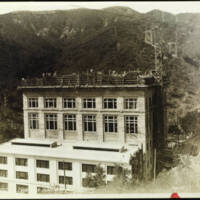
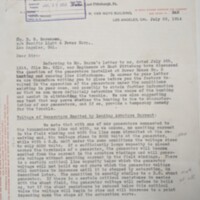
This exhibit examines Caltech’s partnerships with the corporate world in developing electricity transmission to Los Angeles. It focused on the start of Caltech’s work on the transmission problem via the work of Professor Royal W. Sorensen, who founded Catech’s Electrical Engineering department in 1910 (Fox et al., 14). The exhibit traces Sorensen’s work on Eagle Rock and Kern substations as a consulting engineer for Pacific Light & Power, then examines the more large-scale collaboration of Caltech personnel with Southern California Edison in the construction of the High Voltage Laboratory and the subsequent research at the facility.
This exhibit demonstrates the strong and mutually beneficial partnership between Caltech and power companies and shows the important role of Caltech’s expertise in upgrading high voltage transmission lines and powering Los Angeles.
Sources:
Fox, Donna, et al. An Early History of the Caltech EE Department.
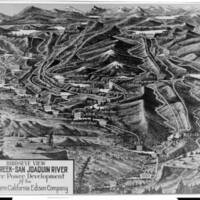
Henry Huntington, buisness mogul and railroad magnate, is responsible in many ways for the early electrification of Los Angeles and its surrounding areas. His trolley system was crucial for the development of the area. However, these projects would not have been possible without his early investment into hydroelectric power plants that provided the power he would need to run his trains.
The power was often supplied by the Southern California Edison Company, with which Caltech was closely involved with in the 1920's with the joint venture of the High Voltage Research Laboratory. Both these later projects in the 1920's and 30's, as well as Huntington's business success, could not have happened without Huntington's early investment into smaller power plants like the Borel Hydro Plant in the 1900's and the Big Creek plant in the 1910's. This exhibition explores how those early plants led to the grand electrification of Southern California.
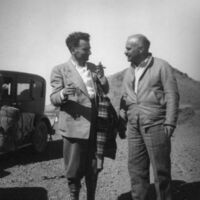
Theodore von Kármán, a pioneering aerospace engineer and founding director of GALCIT and later JPL, is most widely recognized for his contributions to aerodynamics and astronautics. Yet this exhibit highlights his lesser-known but significant involvement in hydraulic engineering, work that proved critical to the development of Southern California's modern water infrastructure.
In November 1933, Caltech and the Metropolitan Water District of Southern California formalized a partnership establishing the Cooperative Hydraulic Machinery Laboratory, completed in August 1934. In the years that followed, the laboratory pursued research across a range of hydraulic topics, including pump efficiency experiments and pumping system designs that directly informed the construction of the Colorado River Aqueduct, a vital system that to this day delivers water from Lake Havasu to greater Southern California. This work formed part of a broader program of government-funded collaboration that contributed to major Western water infrastructure projects in the decade following.
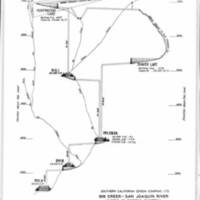
Rapid urban growth and sprawl marked the twentieth century in Los Angeles, leading to increased energy production, investment in scientific research, and transportation initiatives. The Big Creek Hydroelectric Project pushed electricity production well beyond the city’s natural limits, becoming the fuel behind industrialization. The growing energy demand necessitated organization through transportation efforts. A report on the Transportation Problem of Los Angeles from the Caltech Archives outlined below demonstrates the planning behind creating a network around how people, goods, and resources are to be moved across the rapidly growing metroplex. However, to build sustainability around these infrastructures, institutions like the California Institute of Technology became centers for advanced research and training of scientific expertise. The High Voltage Laboratory constructed a way for large amounts of power to be transmitted across long distances. Together, these three pillars (power, infrastructure, and knowledge) became the driving force for the transformation of early Los Angeles.
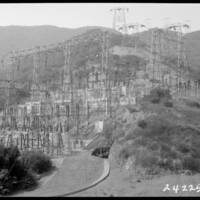
The legacy of Caltech's High Voltage Laboratory goes far beyond the transmission lines that power Los Angeles. In fact, it is the change in goals of High Volts and its partner lab, the Kellogg Lab, that has defined modern Caltech physics research, particularly in nuclear technologies.
LA is powered by hydroelectricity of the Big Creek project. This power goes through Hollywood, Caltech, and the rest of the LA metropolis. The development of stable power lines was initially possible through the work of High Volts. Under Robert Millikan's vision combined with the expertise of C. C. Lauritsen, Caltech transformed this High Voltage Lab into an engineering masterpiece through the million-volt X-ray. But here, the possibilities became endless. X-rays could be used for medical technologies and atomic discovery, which opened a whole new world of exploration. Thus, change in High Volts' goals brought about the modern Caltech physics we know today.
During early days of expansion by the US, California was viewed as a rugged and hostile terrain, deterring settlement. However, the environmental challenges posed by the Western landscape served as the cradle of invention. Donald Worster, author of Rivers of Empire, identified these environmental pressures as a reason for California’s rapid production of technological innovations (Wuebben).
As California settlement increased, the state experienced a rapid demand for transportation and power. Early electrical production took place in hydroelectric dams far away from the areas with the largest power draws (Jackson). For this reason, substations, which were first built in the late 1800s, were used as a means of transforming and transporting power to burgeoning cities (Krieg).
Investigating the means for power transport through substations in California can help us understand early systems for electrical transport and the means used by a state racing to provide power to a booming population.
Jackson, Donald. Jackson, John Eastman, Henry Huntington, and Big Creek. University of Oklahoma Press, 2005.
Krieg, Terry. “Substations.” Springer Handbook of Power Systems, edited by Konstantin O. Papailiou, Springer Singapore, 2021, pp. 867–934. Springer Handbooks. DOI.org (Crossref), https://doi.org/10.1007/978-981-32-9938-2_11.
Wuebben, Daniel L. “California’s Wood Poles, Steel Towers, and Modernist Pylons, 1907–1972.” Power-Lined, University of Nebraska Press, 2019, pp. 87–130. Electricity, Landscape, and the American Mind. JSTOR, https://doi.org/10.2307/j.ctvgfj6b4.8.