Theodore von Kármán and Southern California's Hydraulic Infrastructure
Theodore von Kármán, a pioneering aerospace engineer and founding director of GALCIT and later JPL, is most widely recognized for his contributions to aerodynamics and astronautics. Yet this exhibit highlights his lesser-known but significant involvement in hydraulic engineering, work that proved critical to the development of Southern California's modern water infrastructure.
In November 1933, Caltech and the Metropolitan Water District of Southern California formalized a partnership establishing the Cooperative Hydraulic Machinery Laboratory, completed in August 1934. In the years that followed, the laboratory pursued research across a range of hydraulic topics, including pump efficiency experiments and pumping system designs that directly informed the construction of the Colorado River Aqueduct, a vital system that to this day delivers water from Lake Havasu to greater Southern California. This work formed part of a broader program of government-funded collaboration that contributed to major Western water infrastructure projects in the decade following.
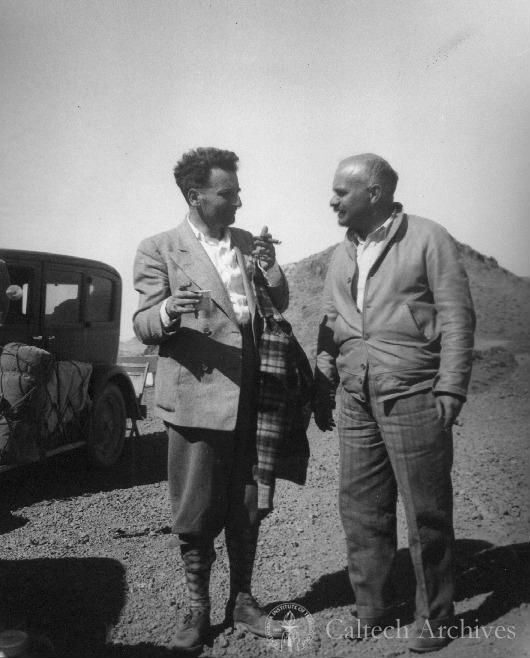
This photograph captures Theodore von Kármán and Raymond Sanger (unknown involvement) during a 1933 visit to Hoover Dam while it was still under construction (1931–1936).
Von Kármán's interest in hydraulics dates back to his early career. Following his graduation from the Royal Joseph Technical University in Budapest, von Kármán was appointed as an assistant in hydraulics, working there for three years. While at the University of Göttingen, he used a large hydraulic press for research on the strength of materials, bridging the gap between fluid dynamics and structural mechanics (Altenbach & Bruhns, 2020).
The visit documented in this photograph coincided as Kármán was working to establish a hydraulic research focus at Caltech. Observations from visits such as this helped shape the goals and research direction of the hydraulics laboratory created at Caltech later that year. That laboratory would go on to work directly on similar hydroelectric infrastructure development projects using a perspective gained from Kármán's expertise in the aeronautical sciences (Heppenheimer 2007).
In 1933, the greater Los Angeles region saw renewed interest in hydraulics as a source of energy and began laying the foundations for a modern Western water–energy infrastructure. Drawing on a lifelong interest in hydraulics, Theodore von Kármán championed the creation of a hydraulics program at Caltech, arguing it would hold “a unique position in this country and almost in the whole world” (Boronkay, 1985).
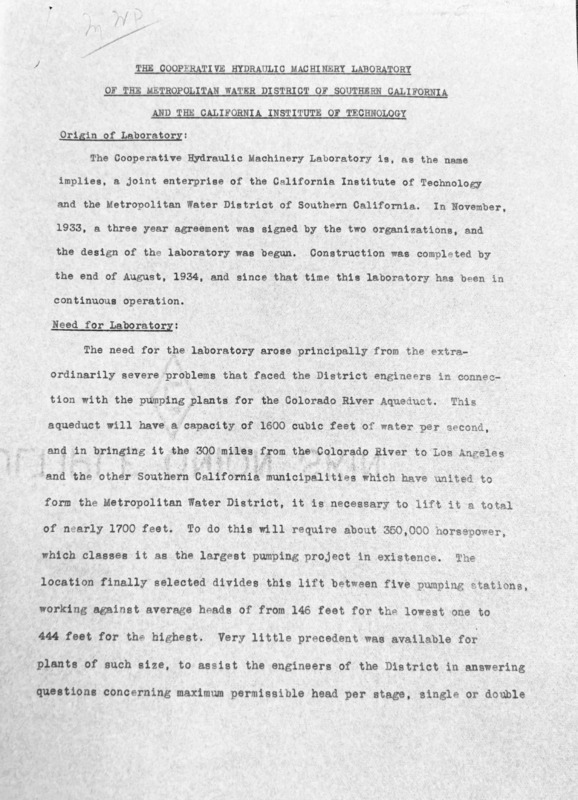
The document shown here is a technical report describing the establishment and early work of the Cooperative Hydraulic Machinery Laboratory (informally known as the Caltech pump lab), a joint research facility created by Caltech and the Metropolitan Water District of Southern California. In November 1933 the two organizations signed a three-year agreement to design and build the laboratory, which was completed in August 1934 and soon placed into continuous operation.
At the time, the laboratory’s primary engineering challenge was addressing problems faced by District engineers in the design of pumping plants for the Colorado River Aqueduct. The aqueduct was planned to deliver roughly 1,600 cubic feet of water per second across nearly 300 miles from the Colorado River to Southern California municipalities. To reach the Los Angeles basin, the water would need to be lifted nearly 1,700 feet, requiring approximately 350,000 horsepower—making it the largest pumping project in existence at the time (Metropolitan Water District of Southern California, n.d.).
Under the supervision of von Kármán, R. L. Daugherty, and R. T. Knapp, the laboratory conducted pump studies and precision model tests to guide the aqueduct’s engineering design. Von Kármán himself played a central role in shaping the laboratory’s direction and work and was marked as an irascible personality within the team (Housner, 1984).
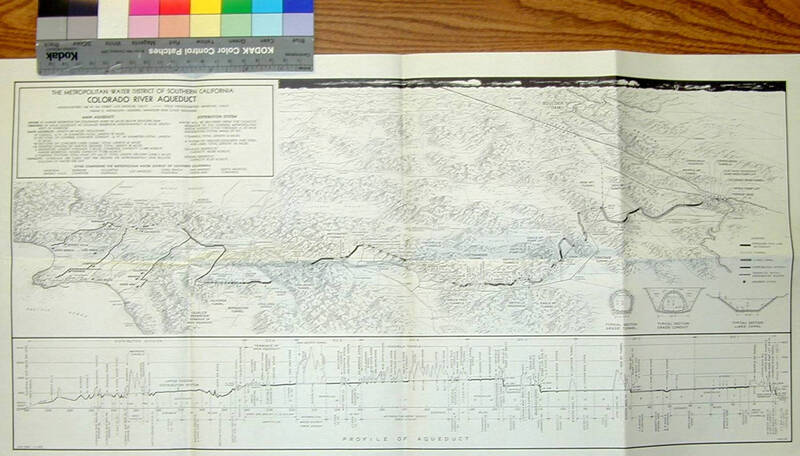
This map of the Colorado River Aqueduct was produced by the Metropolitan Water District of Southern California in April 1936. Stretching nearly 300 miles from the Colorado River to the Los Angeles basin, the aqueduct crossed deserts, valleys, and mountain ranges through an interconnected system of canals, tunnels, reservoirs, and pumping stations.
Engineering profiles recorded key hydraulic conditions along the route, including static head variations of roughly 235 to 320 feet and internal pressures approaching 160 pounds per square inch (Caltech Archives and Special Collections). As such, the aqueduct relied on massive welded steel pipelines nearly fourteen feet in diameter and a series of pumping plants capable of lifting water across large elevation changes. Designing such a system required precise understanding of fluid flow, pressure losses, and pump performance — questions that became a focus of research at the Caltech pump lab.
Kármán's work specifically included comprehensive studies of pumps with different specific speeds and precision acceptance tests of model pumps submitted by contractors for use at locations along the aqueduct route using scaled hydraulic models built and maintained at Caltech (Caltech Archives and Special Collections). This work formed part of a broader program of government-funded collaboration that contributed to major Western water infrastructure projects, including Hoover Dam, Grand Coulee Dam, and the Feather River Project (Von Kármán et al., 1933).
WORKS CITED:
Altenbach, H., & Bruhns, O. T. (2020). Kármán, Theodore von. In Encyclopedia of Continuum Mechanics (pp. 1387–1390). Springer. https://doi.org/10.1007/978-3-662-55771-6_41
Theodore von Kármán Papers, 10143-MS, Box 107, Folder 5. Caltech Archives and Special Collections. Retrieved March 17, 2026, from https://collections.archives.caltech.edu/repositories/2/archival_objects/46084
Boronkay, C. (1985). The sleeping giant must stir. Focus on Water, no. 3. Metropolitan Water District of Southern California.
Heppenheimer, T. A. (2007). Facing the heat barrier: A history of hypersonics (NASA SP-2007-4232). National Aeronautics and Space Administration, History Division. https://archive.aoe.vt.edu/mason/Mason_f/NASASP2007-4232Hypersonics.pdf
Housner, G. W. (1984, July 2, 3, & 11). Interview [Interview]. Conducted by R. Prud'homme. Oral History Project, California Institute of Technology Archives. http://resolver.caltech.edu/CaltechOH:OH_Housner_G
Metropolitan Water District of Southern California. (n.d.). Colorado River Aqueduct virtual tour. Retrieved March 17, 2026, from https://www1.mwdh2o.com/vr-tours/CRA.html?appid=a5e959ec1c544e1cbeaf63d6ecd56128
Von Kármán, T., Bauman, P., Rowe, R. R., Prandtl, L., Pearce, C. E., Brahtz, J. H. A., Heilbron, C. H., Bakhmeteff, B. A., & Mononobe, N. (1933). Von Kármán on pressures on dams during earthquakes. Transactions of the American Society of Civil Engineers, 98(2), 434–470. https://doi.org/10.1061/TACEAT.0004491