Legacy of John S. Eastwood in the Big Creek Hydroelectric System
In 1883, an engineer by the name John S. Eastwood arrived at Fresno and quickly became Fresno’s first city engineer (Moore). However, he was not suited for such a job and in 1895, he became the chief engineer of the San Joaquin Electric Company and developed his first hydroelectric power plant in 1896. Though it was a great engineering feat, the company was financially incapable of building a dam and a long drought bankrupted the company. However, John Eastwood was still set on creating a power plant in the upper San Joaquin River and created Mammoth Power Company in October (Jackson 60). By early 1902, Eastwood decided to expand his previous design to include a network of power plants and dams rather than a singular one. Eventually, Eastwood managed to cooperate with the Pacific Light and Power Company (PL&P) to build dams and power plants at Big Creek.
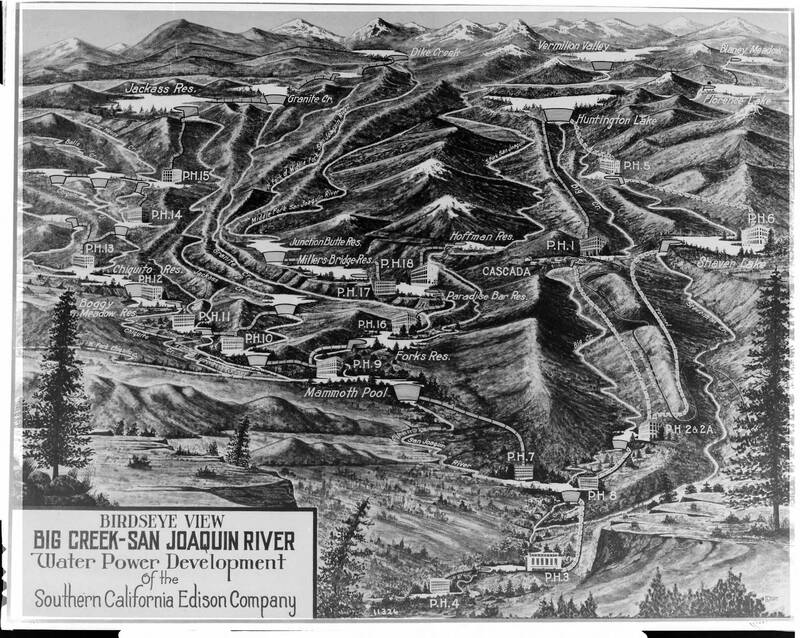
This image showcases a design of 18 powerhouses to be built at Big Creek, representing John S. Eastwood’s ambitious vision for a large-scale hydroelectric network based near the San Joaquin River. Sourced from the Southern California Edison Photographs and Negatives, it likely reflects Eastwood's detailed plan to harness the full might of the San Joaquin River watershed through a system of dams, reservoirs, and powerplants rather than a single facility.
However, Eastwood was gradually removed from the building process as he fell out of favor with the upper management of PL&P, preventing him from overseeing much of the process (Jackson 78). As Johnson notes, “Eastwood envisioned 18 powerhouses, [though] only half were built” highlighting the gap between his grand vision and the system’s final form.
Currently, the Big Creek Hydroelectric “system consists of nine major powerhouses, six major reservoirs, numerous dams and small diversions, various water conveyance facilities, access roads, electrical transmission lines, and other appurtenant facilities” (California Water Boards). Though it may not be as impressive as the system that Eastwood had designed in this image, it remains a crucial power source and a key player in the development of electricity in Los Angeles.
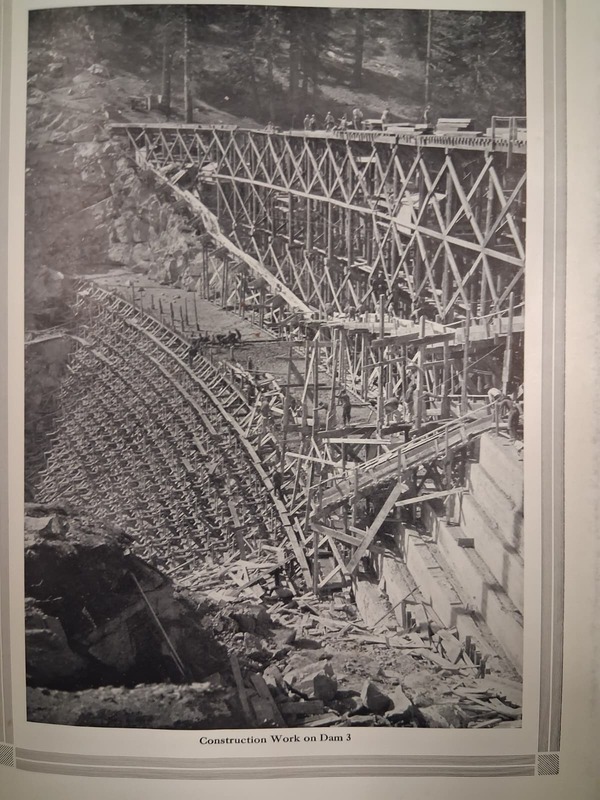
This image shows the construction of Big Creek Dam 3, with wooden formwork carefully arranged to shape the concrete structure. The photograph captures a critical stage in building the hydroelectric system, revealing the labor, ingenuity, and organization required to translate John S. Eastwood’s vision into reality. Workers and engineers erected extensive wooden frames to guide the pouring of concrete, a technique essential for creating the reinforced structures that would control and direct the San Joaquin River’s flow.
Although Eastwood had already been removed from the project by this stage after being officially cast out in 1912, his pioneering use of reinforced concrete and his emphasis on efficient dam design continued to influence construction methods (Jackson 75). According to a paper by Greg A. Scott et. al., concrete dams entered a state of evolution at the turn of the 20th century (Scott 3). Eastwood contributed greatly to this advancement in engineering with his designs of dams at Big Creek and even invented a new concept which he called the multiple arch dam which he claimed could significantly reduce costs while also providing stronger structural integrity.
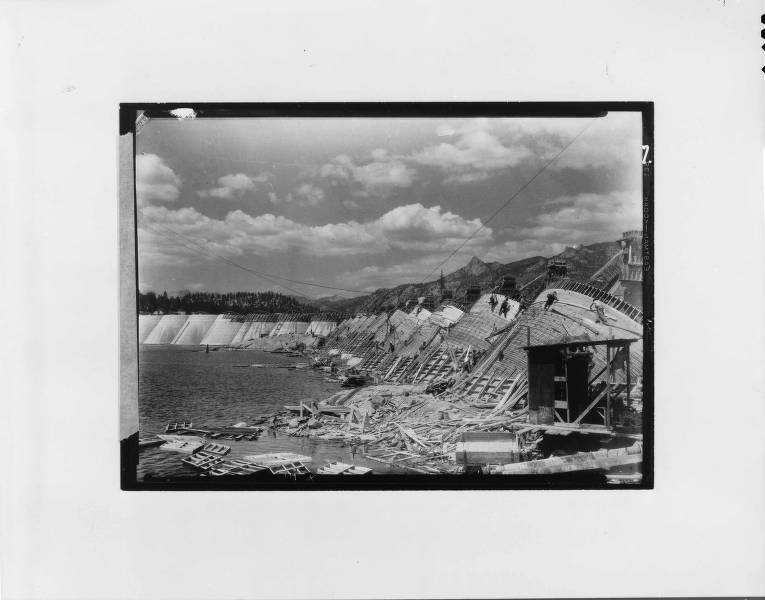
Eastwood designed the multiple arch dam in 1906 and despite the overwhelming advantage, his attempts to persuade the upper management of PL&P, his suggestions were repeatedly rejected or ignored (Jackson 72). However, when the Southern California Edison Company assumed control of the Big Creek project, they recognized the value of Eastwood’s design and constructed the Florence Lake Dam in 1926 according to his plans. According to Laurence H. Shoup, it was the longest multiple arch dam of its time with a width of over 3000 feet (Shoup 125).
This image depicts the Florence Lake Dam, a testament to Eastwood’s innovative engineering and his enduring influence on hydroelectric development in California. The dam’s multiple-arch design efficiently distributes water pressure across a series of arches, reducing the amount of concrete required while maintaining structural strength. Though Eastwood was no longer directly involved in the project, the Florence Lake Dam represents the realization of his vision and serves as a lasting legacy of his contributions to the Big Creek Hydroelectric System.
Works Cited
Big Creek Hydroelectric System | California State Water Resources Control Board. https://www.waterboards.ca.gov/waterrights/water_issues/programs/water_quality_cert/big_creek/. Accessed 5 Feb. 2026.
Jackson, Donald C. Building the Ultimate Dam: John S. Eastwood and the Control of Water in the West. University Press of Kansas, 1995.
Johnson, John. “Lights Dim in an Edison Company Town.” Los Angeles Times, 21 Aug. 2000, https://www.latimes.com/archives/la-xpm-2000-aug-21-mn-7792-story.html.
Moore, Joe. “John Eastwood: The Fresno Engineer Who Helped Transform the Sierra and Southern California.” KVPR, 26 June 2025,
https://www.kvpr.org/podcast/central-valley-roots/2025-06-26/john-eastwood-the-fresno-engineer-who-helped-transform-the-sierra-and-southern-california.
Scott, Gregg A., et al. “Concrete Dam Evolution.” U.S. Bureau of Reclamation, 21 Sept. 2002,
http://www.riversimulator.org/Resources/USBR/ReclamationHistory/ConcreteDamEvolution.pdf.
Shoup, Laurence H., et al. “The Hardest Working Water in the World”: A History and Significance Evaluation of the Big Creek Hydroelectric System. Archaeological and Historical Consultants, Inc., Oct. 1988,
https://ia.cpuc.ca.gov/environment/info/esa/sjxvl/SCE_DRs/DR6/DR6_attachment.pdf.