Transition of Power: Defining Caltech's Physics Department through Changes in the High Voltage Laboratory
The High Volts Laboratory and Kellogg Laboratory of Caltech have defined physics research and education over the last century. Here, we see how the transition of High Volts' focus from electric transmission to high-energy X-rays and eventually nuclear physics defined the modern physics curriculum of the institution.
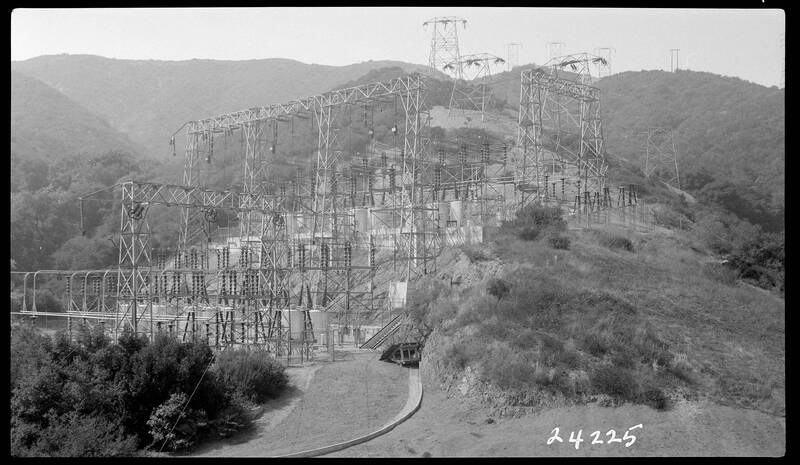
Eagle Rock Substation was a result of the work that the High Voltage Laboratory at Caltech performed on transmission lines. Without the work of High Volts, the LA metropolitan area would be unable to grow electrically. Eagle Rock serves as the ending point of the Big Creek project, bringing hydroelectric power to the LA community. (Water and Power Associates).
Eagle Rock Substation has also served its cultural purpose as a location for the filming site of many movies, including Oscar-winning movie "The Artist" (Milbourn). Now, while Eagle Rock grew to power LA's ever-growing electric demands, the High Voltage Laboratory pivoted away from high-voltage transmission lines. This move away from connecting renewable energy opened space for High Volts to become a growing nuclear research leader prior to World War II.
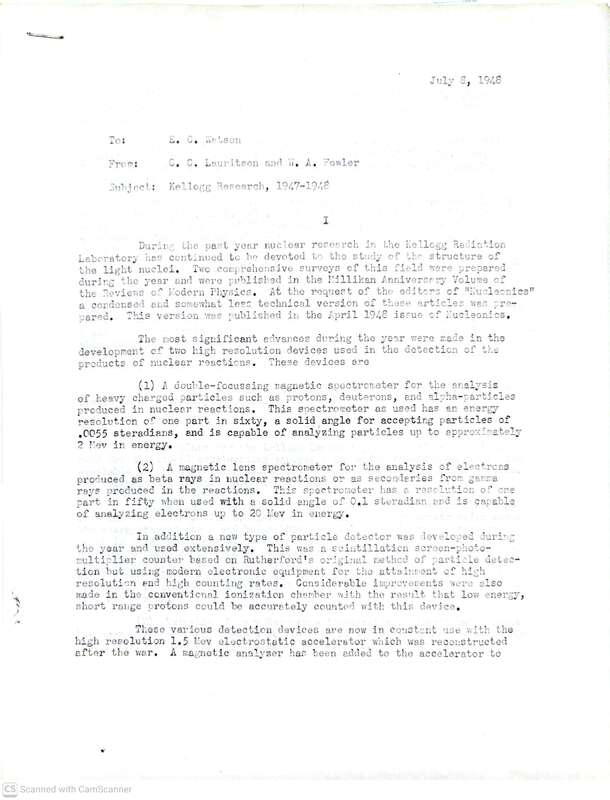
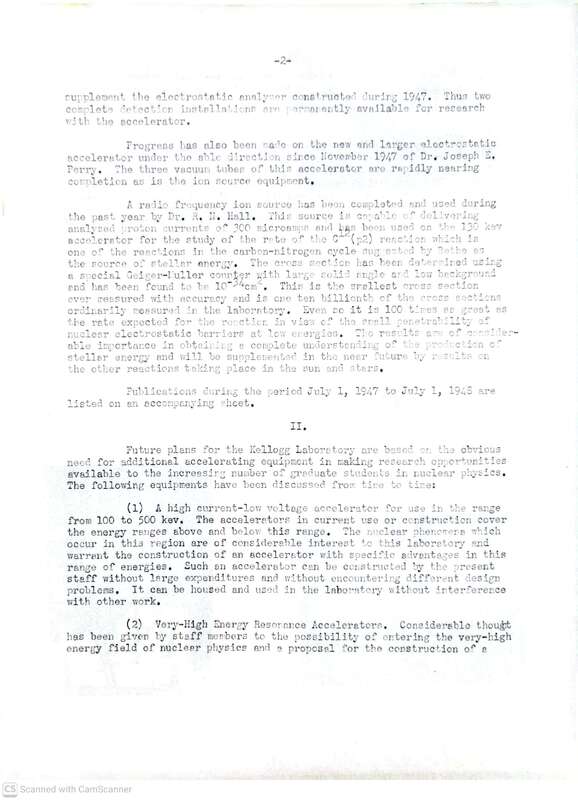
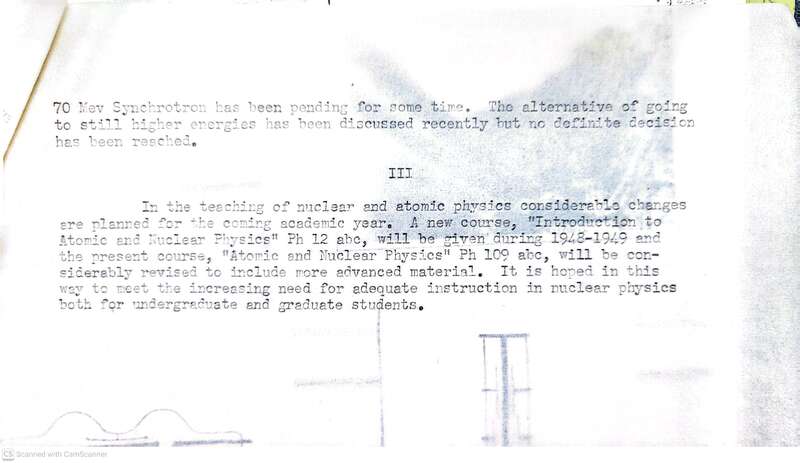
Lauritsen and Fowler’s 1948 memorandum defines the Kellogg Lab’s post-WWII pivot from high-voltage X-rays toward fundamental nuclear research. This transition is clear when we look at Caltech's 1942 Big T, a student yearbook prior to end of WWII. It emphasized the connection from the High Voltage Laboratory to the broader LA community, like Hollywood recording studios, through Westinghouse and the Southern California Edison Company (California Institute of Technology). However, this emphasis on high-voltage transmission and X-rays faded, as seen through the Kellogg Lab's new goals shown in the memorandum.
Robert Millikan failed at sustaining X-ray medical technology research at Caltech - a key focus of the Kellogg Lab - due to funding challenges and medical X-ray commercialization (Holbrow). Soon afterwards, the memo shows how the lab shifted towards stellar energy research. The institution as a whole responded through the formalization of physics courses like Ph 12abc and Ph 109abc that moved away from high-voltage transmission and urban electrification towards atomic discovery.

This photograph shows a defining moment in the early shape of physics research and study at Caltech: Charles C. Lauritsen and Robert A. Millikan standing atop the million volt X-ray tube at Caltech's High Voltage laboratory (c. 1928).
Initially, work at Caltech's High Voltage Laboratory (Hi Volts) powered Los Angeles through long-distance power lines, including lines to the Hoover Dam (Fowler). However, C. C. Lauritsen's move to Caltech in 1926 started a transition towards prolific nuclear physics research at the institute. Using his experience with radios, Lauritsen built the million-volt X-ray tube in 1928, and his electroscope innovation made a statement of Hi Volts' ability to use simple hand-held devices to perform large-scale calculations and phenomenological detections. Lauritsen's high-voltage innovations prompted Millikan to request W. K. Kellogg for financing a new laboratory. (Lauritsen; Fowler)
The creation of the million volt X-ray tube brought a paradigm shift in Caltech's physics research. Because these tubes were far more powerful than standard hospital tubes, Caltech was able to explore cancer therapy with high-voltage X-rays. By the 1930s, these medical X-ray technologies moved to the Kellogg Radiation Lab, leaving space for Hi Volts to expand its nuclear physics research and programs prior to World War II. Unfortunately, Kellogg's X-rays were turned off in 1939 due to commercialization of tubes in hospitals. (Lauritsen)
While Caltech's labs pivoted towards defense projects during WWII, all war-related work was eventually transferred to China Lake in 1945. With the war did come changes in the goals of the Kellogg lab, with Lauritsen pushing towards low-energy physics, leading towards observation of nuclear reactions in stars. (Fowler)
Works Cited
California Institute of Technology. The Big T, 1942 - CaltechCampusPubs. resolver.caltech.edu/CaltechCampusPubs:20111024-135709577.
Fowler, William A. “Phyphty Years of Phun and Physics in Kellogg.” Engineering & Science, Mar. 1982, resolver.caltech.edu/CaltechES:45.4.Phowler.
Holbrow, Charles H. “The Giant Cancer Tube and the Kellogg Radiation Laboratory.” Physics Today, vol. 34, no. 7, July 1981, pp. 42–49. https://doi.org/10.1063/1.2914646.
Lauritsen, Thomas. “Kellogg Laboratory: The Early Years.” Engineering & Science, June 1969, resolver.caltech.edu/CaltechES:32.9.kellogg.
Milbourn, Mary Ann. “Lights, Camera, Edison!” Energized by Edison, 24 Feb. 2016, energized.edison.com/stories/lights-camera-edison.
Water and Power Associates. waterandpower.org/Museum2/Eagle_Rock.html.